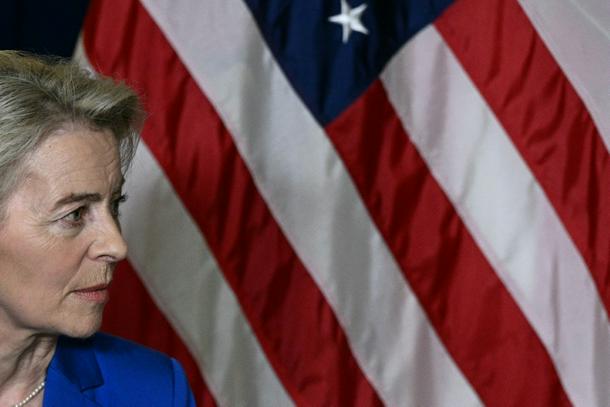
Europe is watching for shifts from the United States after President Donald Trump's Republicans were routed at the midterm elections
Brussels (Belgium) (AFP) - There may be jubilation in Europe after a stunning rout of the Republicans in the US midterm elections left President Donald Trump weakened.
But there are no guarantees that the political earthquake will change key US policies.
Here are the areas Europeans will be watching for a shift:
- Trump reined in? -
After a rollercoaster of tariffs, trashing Ukraine, and threats to Greenland, diplomats in Brussels were welcoming the results.
“There is relief here that this is the beginning of the end of the Trump era and nobody is happier than Europeans,” one diplomat told AFP, granted anonymity like others to discuss the issue.
The first expectation appears that the Democratic victories could help rein in Trump and begin righting the ship – at least at home.
“Hope is that with checks and balances some confidence will come back in the US system,” said a second senior EU diplomat.
But there is also a clear sense that America’s inward turn under Trump is unlikely to halt.
“If anything the US will turn even more inwards and focus on the domestic political fight between the White House and the Congress,” a third diplomat said.
Meanwhile on the international stage Trump should still have a freer hand – and get even more aggressive.
“Trump still has executive powers and has been ignoring Congress,” the same diplomat said.
- Ukraine -
Despite the caution, Europe dearly wants to see a shift in Washington’s approach to the war in Ukraine.
Ahead of the midterms, Trump yet again lashed out at Ukraine and cosied up to Russia as Washington has renewed its push to end the fighting.
The Democrat win will now usher in a more vocal pro-Kyiv majority in Congress that could pressure Trump to change tack.
But there is little hope that the United States will go back to being a major financial backer for Ukraine.
Officials in Brussels say they are focused on plugging a 70-billion-euro ($79 billion) hole in Kyiv’s finances next year.
And while they’re pushing other countries such as Britain, Canada and Japan to do more, they are certainly not counting on the United States.
- Iran -
As the impact of Trump’s Iran war continues to send inflation up in Europe, the continent is anxiously eyeing what happens next in the Middle East.
But with Washington carrying out fresh strikes in recent days, there are fears that the situation could escalate again now the midterms have passed.
Throw in as well the unpredictable situation in Israel, where Trump ally Benjamin Netanyahu is engaged in his own post-election horse-trading.
- Troops -
At NATO, Washington’s European allies are nervously waiting for the results of a Pentagon review of US forces on the continent that looks set to be unveiled in December.
Multiple diplomats have previously said they do not expect the midterms to impact the result.
Now with the Democrats threatening to go after US Defense Secretary Pete Hegseth, one of the most aggressive voices on Europe could be under fire at the Pentagon.
Despite that, Europeans remain clear-eyed and insist they are not backing down on efforts to take more responsibility for their own security.
- Tariffs -
One of Europe’s major bugbears with Trump are the tariffs he’s imposed.
Getting him to backtrack on one of his centrepiece economic policies seems unlikely.
Democrats seeking to bring down inflation could try to roll back some of the measures.
But some look likely to stick around.
In a recent poll from the Washington-based Council on Foreign Relations, only one quarter of Americans backed removing all the tariffs on the EU.
- Digital -
Another area of conflict has been Trump’s opposition to the EU efforts to curb big tech.
Now with the Democrats pledging to crack down on the power of Silicon valley – Europe is hoping it won’t face such strong headwinds.
“We will not change our enforcement of our digital rules, and we don’t expect changes on such issues with the White House,” an EU official told AFP.
“But we expect more room to discuss, to cooperate with Congress on global shared challenges” such as AI and cyber security.