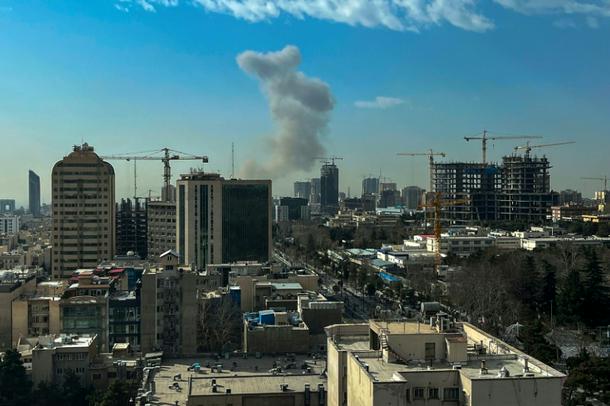
Smoke rose above Tehran after explosions were heard
Tehran (AFP) - The United States and Israel launched what the latter called a “decisive and unprecedented” campaign against Iran, which retaliated with a barrage of missiles that sent residents running for cover on Saturday in cities across the Middle East.
Iranian authorities sent text messages urging residents to evacuate the capital – a city of 10 million – and a strike on a school in southern Iran killed 85 people, the judiciary said, although AFP was unable to access the site in order to verify the toll.
Meanwhile, the UAE reported missile damage in Dubai and Abu Dhabi and one civilian dead in an Iranian attack, as blasts from air defences and Tehran’s missile salvo also echoed over Saudi Arabia, Bahrain, Qatar, Jordan and Kuwait – as well as Israel.
In weeks of sabre-rattling leading up to the strikes, Tehran had repeatedly vowed to retaliate fiercely if attacked, and Foreign Minister Abbas Araghchi argued on Saturday that US and Israeli installations around the region involved in the operation were “legitimate targets”.
Plumes of black smoke hung over Tehran, including in the Pasteur district, site of the home of supreme leader Ayatollah Ali Khamenei, and there was a huge security deployment in the capital.
“Iranian Supreme Leader Khamenei and President Masoud Pezeshkian were among the targets of the attack,” Israel’s public broadcaster reported, citing an Israeli source.
But Araghchi told NBC News that Khamenei was alive “as far as I know”, adding that “all high ranking officials are alive”.
An Israeli military official said several senior figures were “eliminated” in strikes on gatherings of Iranian officials.
Tehran residents had been going about their usual business when the strikes began. Security forces quickly flooded the streets, shops pulled down their shutters and few pedestrians risked venturing out, an AFP journalist saw.
“I saw with my own eyes two Tomahawk missiles flying horizontally toward targets,” a Tehran office worker told AFP before communications and internet access were cut, a step authorities typically take during periods of heightened tension.
More than 20 of Iran’s 31 provinces were affected by the strikes, the country’s Red Crescent Society said.
Pezeshkian decried the deadly attack on the girls’ school in the south, calling it a “barbaric act”.
Across Israel, city streets stood deserted as residents took cover in shelters, while the blasts of intercepted Iranian missiles reverberated overhead. Emergency services reported two people injured.
- ‘Eliminating imminent threats’ -
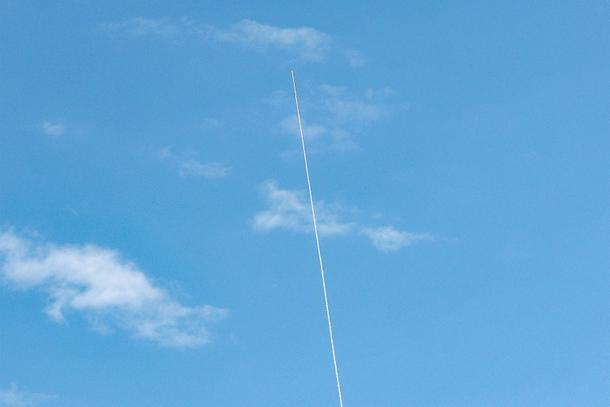
Rocket trails from Israel's Iron Dome missile defence system were seen over Tel Aviv
The attacks came after US President Donald Trump expressed frustration at Iran’s stance in negotiations over its nuclear and missile programmes.
Trump said Washington’s goal was “eliminating imminent threats” from Iran, while Israel’s Prime Minister Benjamin Netanyahu said the operation was to remove an “existential threat”.
“We are going to destroy their missiles and raze their missile industry to the ground,” Trump said, warning of possible US casualties.
He also told Iranians the “hour of your freedom is at hand”, urging them to rise up and “take over your government”.
It was the first US military action of this scale apparently aimed at toppling a foreign government since the 2003 invasion of Iraq.
Netanyahu echoed Trump’s call, telling Iranians that the time had come to “cast off the yoke of tyranny”.
Israel’s army chief Lieutenant General Eyal Zamir said the operation was “taking place at a completely different scale” than the 12-day war it fought against Iran in June, which the US briefly joined.
“We now face a significant, decisive and unprecedented operation to dismantle the capabilities of the Iranian terrorist regime,” he later said in a televised statement.
The army said it had completed a “broad strike” against Iran’s defence systems, and was now “currently striking missile launchers in Iran to thwart the threat posed to the State of Israel”.
Iran’s Revolutionary Guards said: “The IRGC’s missiles and drones have struck the headquarters of the US Navy’s Fifth Fleet in Bahrain and other American bases in Qatar and the United Arab Emirates, as well as military and security centres in the heart of the occupied territories (Israel), with severe blows.”
Iran, Iraq, Kuwait, Syria, the UAE and Israel all closed their airspaces to civilian traffic, at least in part, and multiple airlines cancelled flights to the Middle East.
- Blasts across Gulf -
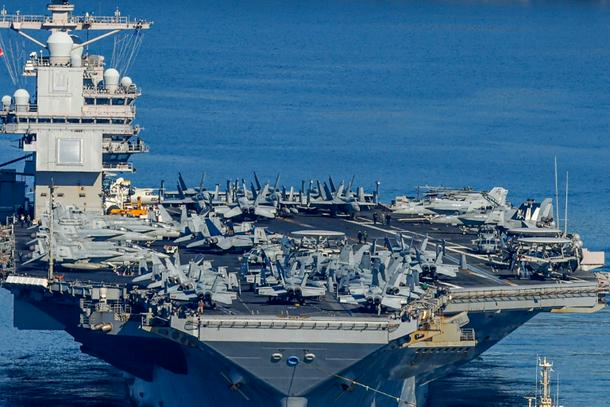
The US Navy aircraft carrier USS Gerald R. Ford was part of the huge build-up of forces in the region ahead of the strikes
Residents and AFP correspondents in the Emirati, Qatari and Bahraini capitals heard multiple rounds of explosions from Iran’s retaliatory strikes.
In Qatar, people fled in panic as a falling missile plunged into a residential neighbourhood, erupting in a fireball as it hit the street.
And in Abu Dhabi, the United Arab Emirates’ capital, golfers enjoying a quiet round were stunned to see dozens of projectiles flying overhead.
In Bahrain’s capital Manama, residents were hurriedly evacuated from the Juffair district housing the US navy’s Fifth Fleet.
“When we heard the sounds, we cried out of fear,” said Jana Hassan, a 15-year-old student who was visiting a friend in the area. “I will never forget the sound of those loud blasts.”
Two witnesses told AFP they heard an explosion and saw a plume of smoke rising from Dubai’s famed man-made island The Palm as authorities reported four injured.
The foreign ministry of Oman, a mediator in recent US-Iran talks, called “on all parties to immediately cease military operations and urges the United Nations Security Council to convene an emergency meeting to impose a ceasefire”.
burs/smw/dc