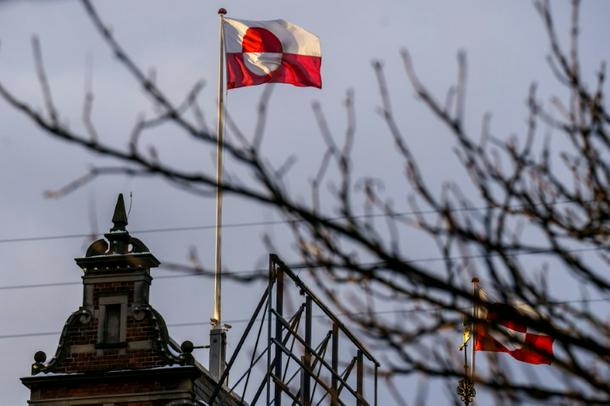
Several European countries have backed Greenland and Denmark over Trump's claims to the territory
Copenhagen (AFP) - Denmark’s prime minister on Sunday said her country faces a “decisive moment” in its diplomatic battle with the United States over Greenland, after President Donald Trump again suggested using force to seize the Arctic territory.
Ahead of meetings in Washington from Monday on the global scramble for key raw materials, Prime Minister Mette Frederiksen said that “there is a conflict over Greenland”.
“This is a decisive moment” with stakes that go beyond the immediate issue of Greenland’s future, she added in a debate with other Danish political leaders.
Frederiksen posted on Facebook that “we are ready to defend our values – wherever it is necessary – also in the Arctic. We believe in international law and in peoples’ right to self-determination.”
Germany and Sweden backed Denmark against Trump’s latest claims to the self-governing Danish territory.
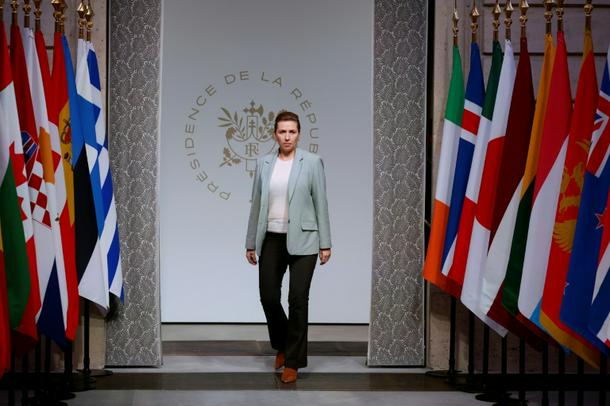
Denmark's Prime Minister Mette Frederiksen has issued a new warning over Greenland
Swedish Prime Minister Ulf Kristersson condemned US “threatening rhetoric” after Trump repeated that Washington was “going to do something on Greenland, whether they like it or not”.
“Sweden, the Nordic countries, the Baltic states, and several major European countries stand together with our Danish friends,” he told a defence conference in Salen where the US general in charge of NATO took part.
Kristersson said a US takeover of mineral-rich Greenland would be “a violation of international law and risks encouraging other countries to act in exactly the same way”.
- No ‘immediate threat’ -
Germany reiterated its support for Denmark and Greenland ahead of the Washington discussions.
Before meeting US counterpart Marco Rubio on Monday, German Foreign Minister Johann Wadehpul held talks in Iceland to address the “strategic challenges of the Far North”, according to a foreign ministry statement.
“Security in the arctic is becoming more and more important” and “is part of our common interest in NATO”, he said at a joint news conference with Icelandic Foreign Minister Thorgerdur Katrin Gunnarsdottir.
“If the American president is looking at what threats might come from Russian or Chinese ships or submarines in the region, we can of course find answers to that together,” he added.
But “the future of Greenland must be decided by the people of Greenland” and Denmark, he said.
Asked about a possible strengthening of NATO’s commitment in the Arctic, Wadephul said Germany was “ready to assume greater responsibilities”.
Earlier Sunday, German Finance Minister Lars Klingbeil said: “We are strengthening security in the Arctic together, as NATO allies, and not against one another.”
He was speaking ahead of an international meeting on critical raw materials in Washington.
European nations have scrambled to coordinate a response after the White House said this week that Trump wanted to buy Greenland and refused to rule out military action.
On Tuesday, leaders of seven European countries including France, Britain, Germany and Italy signed a letter saying it is “only” for Denmark and Greenland to decide the territory’s future.
Trump says controlling the island is crucial for US national security because of the rising Russian and Chinese military activity in the Arctic.
NATO Supreme Allied Commander General Alexus Grynkewich told the Swedish conference that alliance members were discussing Greenland’s status.
While there was “no immediate threat” to NATO territory, the Arctic’s strategic importance was fast growing, the US general added.
Grynkewich said he would not comment on “the political dimensions of recent rhetoric” but talks on Greenland were being held at the North Atlantic Council.
“Those dialogues continue in Brussels. They have been healthy dialogues from what I’ve heard,” the general said.
A Danish colony until 1953, Greenland gained home rule 26 years later and is contemplating eventually loosening its ties with Denmark. Polls indicate that Greenland’s population strongly oppose a US takeover.
“I don’t think there’s an immediate threat to NATO territory right now,” Grynkewich told the conference.
But he said Russian and Chinese vessels had been seen patrolling together on Russia’s northern coast and near Alaska and Canada, working together to get greater access to the Arctic as ice recedes due to global warming.
burs-jj/des