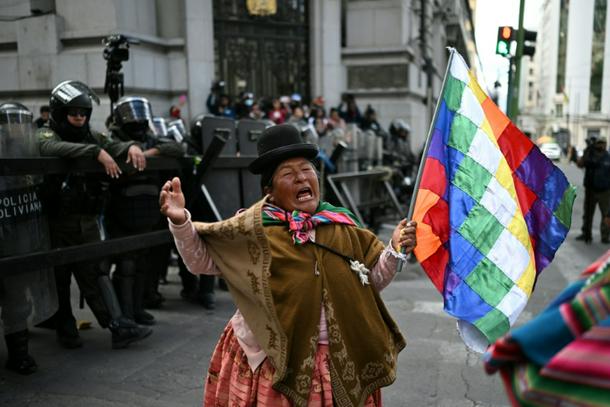
An Indigenous woman protests against the government of President Rodrigo Paz on Mother's Day in La Paz
La Paz (AFP) - President Rodrigo Paz warned Wednesday that Bolivia was at a “breaking point” after nearly a month of protests that have caused shortages of food, fuel and life-saving medicine.
The US-backed Paz, who took office six months ago amid the worst economic crisis here in four decades, is battling a groundswell of fury over his center-right policies.
The political capital La Paz has been besieged by low-income workers and members of the majority Indigenous majority calling for his resignation.
“The country needs order, and is reaching breaking point,” the 58-year-old leader said at a public event in La Paz, renewing his appeal for dialogue.
On Tuesday, Congress lifted restrictions on him announcing a state of emergency, paving the way for Paz to possibly deploy troops to restore order.
Paz has so far emphasized the need for dialogue but has not ruled out using “constitutional instruments” to end the blockade of La Paz – an allusion to declaring a state of emergency.
“Anyone who wants to destroy the nation will have to deal with this president and the full force of the Constitution,” he said on Wednesday, assuring the police and military that they had the public’s support.
- ‘Not afraid to die’ -
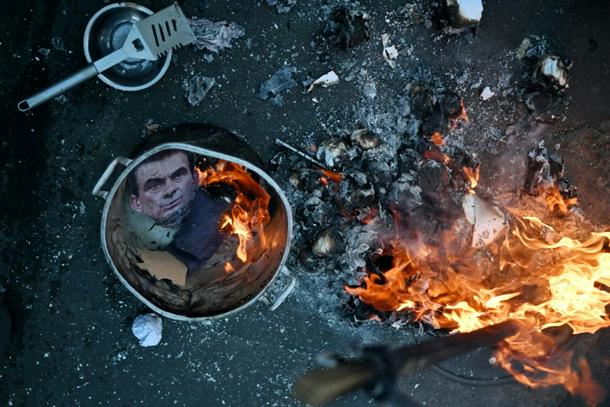
Protesters burned an effigy of Bolivia's center-right president Rodrigo Paz during a protest
His warnings came as thousands of Indigenous women in traditional layered skirts marched through La Paz on Mother’s Day in Bolivia, in support of striking transport workers.
“We are not afraid to die. We have already told him to pack his bags and leave,” protestor Marta Poma Luque told AFP, referring to Paz.
The demonstrations began in early May with demands for salary increases to help workers weather a severe economic crisis, stable fuel supplies and the rescinding of an unpopular agrarian reform.
Despite some concessions by Paz, including on the land reform, the protests ballooned into a full-blown revolt.
Over the past two weeks, La Paz has been turned into a battleground, with riot police repeatedly clashing with protesters.
His government accuses ex-president Evo Morales – in hiding from charges of trafficking a teenage girl with whom he allegedly fathered a child – of orchestrating the upheaval.
But Morales told AFP in an interview Wednesday that Bolivians are furious because Paz oversees “a government that is utterly submissive” to Washington.
“I am totally convinced this rebellion is against the neo-liberal model and the neo-colonial state,” said Morales, who led Bolivia from 2006 to 2019 and fled to Mexico amid a popular uprising against him after a disputed election. He returned from exile in 2020.
Bolivia’s first Indigenous president spoke in a virtual interview from his political stronghold in the coca-growing Chapare region. He is holed up there to elude arrest on the charges of sexually abusing a minor.
- Oxygen shortage -
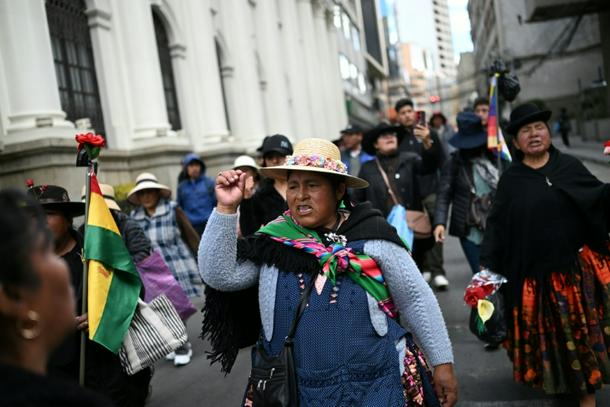
Indigenous women take part in a protest against the government of Bolivian President Rodrigo Paz
In recent days, La Paz residents have staged small counterdemonstrations against the blockades that are preventing essential supplies from getting through to the city.
“Medicine is getting more expensive, and some are running out,” said Zulm Hinojosa, whose 13-year-old son suffers from asthma and heart problems.
At the Clinicas de La Paz public hospital, one of the oldest and largest in the country, doctors told AFP on Tuesday they only had a few days’ oxygen left.
Paz has estimated the losses caused by the protests at $600 million.
Paz has attempted to quell the protesters’ fury by saying he will cut his own salary in half in solidarity with the poor – a purely symbolic gesture since his monthly earnings come to around 24,000 bolivianos ($3,500).
He has also vowed to give Indigenous groups and labor unions more of a say in policy-making and fired his unpopular labor minister – all to no avail.