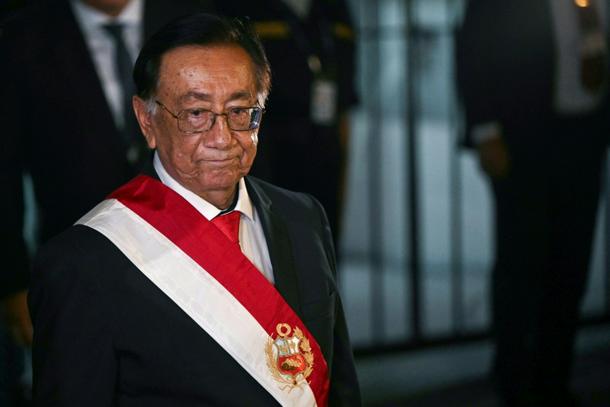
Interim president Jose Maria Balcazar said he would leave it up to the next elected leader to finalize the F-16 deal
Lima (AFP) - Peru’s foreign and defense ministers resigned on Wednesday in protest over the interim president’s decision to stall a $3.5 billion deal for the purchase of 24 US F-16 fighter jets.
The ministers said the deal had already been signed and that to cast doubt on it now jeopardized Peru’s reputation as a trading partner.
Despite the president’s declared wish to suspend the purchase, the Ministry of Economy announced late Wednesday that it had transferred $462 million as part of an initial payment for the contract with aircraft manufacturer, Lockheed Martin.
The confusion over the purchase and the abrupt resignations deepened instability gripping the South American country, after a recent election to choose the country’s ninth president in a decade descended into chaos.
No candidate emerged with an outright majority, meaning a runoff election will be held June 7.
Interim president Jose Maria Balcazar said Tuesday he would leave it up to the victor to finalize the jets deal.
The US ambassador to Peru, businessman Bernardo Navarro, on Friday issued a warning widely believed to relate to the agreement.
“If you deal with the US in bad faith and undermine US interests, rest assured, I, on behalf of @POTUS Trump and his administration, will use every available tool to protect and promote the prosperity and security of the United States and our region,” Navarro wrote on X.
He later told Exitosa radio station that the deal is for two squadrons of 12 F-16 fighter jets, with the first 12 to start arriving in 2029.
- ‘Not seeking confrontation’ -
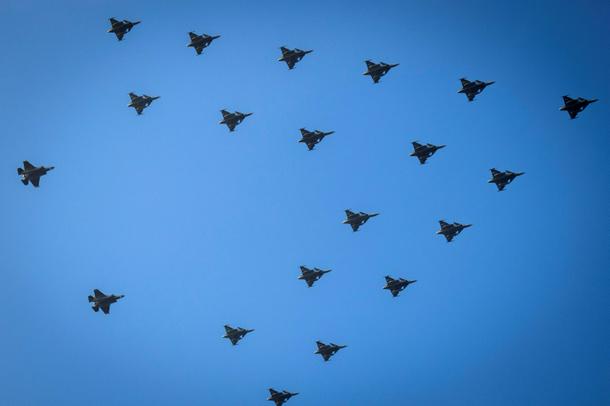
Top Peruvian ministers quit over a stalled $3.5 billion deal for the purchase of 24 US F-16 fighter jets
On Wednesday, Balcazar went on state TV to assure Peruvians that he was “not seeking confrontation with the United States.”
He said he halted the defence deal to ensure that public funds were “used appropriately, reasonably, in accordance with the significant social gaps we have to address in the country.”
Foreign Minister Hugo de Zela said the decision “endangers our country and undermines its credibility.”
He claimed the contracts for the F-16s were signed on Monday, after being approved by the National Defense Council, and that an initial payment was due on Wednesday.
Defense Minister Carlos Diaz said the purchase of jets was not political but “for the security and defense of the nation.”
Balcazar, who replaced a previous interim leader who was impeached, denied on Tuesday that the sale of the jets had already gone through.
His term ends on July 28.
- US warning -
Congress President Fernando Rospigliosi urged Balcazar to honor the deal with the United States to avoid a “political, legal and geopolitical problem.”
Ultraconservative congressman Jorge Montoya suggested making Balcazar the fifth president in 10 years to be impeached.
In October 2024, Peru announced that it would renew its aging air defense fleet with the purchase of state-of-the-art fighter jets.
A state evaluation committee last year chose the F-16s over rival bids from France’s Rafale and Sweden’s Gripens, citing technical and geopolitical criteria.
Peru currently has 12 Mirage 2000 aircraft, according to defense publications.
Its combat fleet also includes Russian MiG-29s and Belarusian Sukhoi Su-27s, most of which are inoperative or in reserve.
The deal with the United States has become swept up in a presidential election marred by logistical problems, unsubstantiated fraud allegations and delays to the ballot count.
Ten days after Peruvians voted in the first round, it is still not known who will face off against conservative frontrunner Keiko Fujimori in June’s second round.
Ultraconservative former Lima mayor Rafael Lopez Aliaga is locked a tight race with leftist ex-minister Roberto Sanchez for the second runoff spot.
Lopez Aliaga has alleged election fraud and called for the vote to be annulled.
The final results have been delayed by legal challenges.
The election was dominated by calls for a security crackdown to end an extortion epidemic and related wave of contract killings.