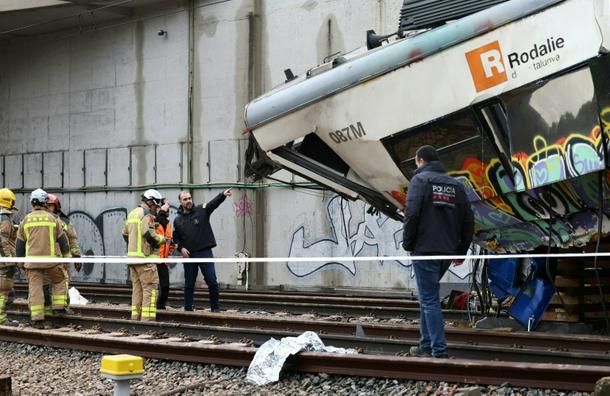
Rail operator Adif said it was likely the wall collapsed after heavy rain
Barcelona (AFP) - Spain’s railway system was under scrutiny on Wednesday after a commuter service crashed near Barcelona, days after at least 43 people were killed in a collision between two high-speed trains.
A train driver died and 37 people were injured – several seriously – in the latest incident late on Tuesday. The commuter train hit a retaining wall that fell onto the tracks in Gelida near Barcelona, regional officials said.
Railway operator Adif said the wall likely collapsed due to heavy rainfall that has swept across Spain’s northeastern region of Catalonia in recent days.
Spain was already reeling from Sunday’s collision in the southern region of Andalusia, the country’s deadliest rail accident in more than a decade.
Another body was recovered Wednesday at the site of the accident near the village of Adamuz, bringing the confirmed death toll to 43, authorities said.
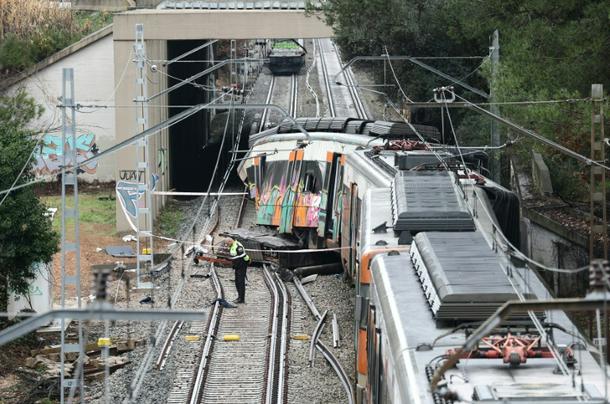
A train driver died and 37 people were injured in the second incident
“This is too much,” the head of the conservative main opposition Popular Party, Alberto Nunez Feijoo, wrote on X. His party demanded an “immediate clarification” of the state of the nation’s railways.
Speaking to reporters on Tuesday before the Barcelona-area crash, far-right party Vox’s spokeswoman Pepa Millan said Spaniards were now “afraid to get on a train”.
Raluca Maria Pasca, a 45-year-old waitress, said she had noticed that high-speed trains “have been shaking lately”.
“I’ve felt it myself. They need to fix the problem,” she told AFP at the train station in the southern city of Cordoba.
Alexandra Leroy, a restaurant owner from France who was on holiday in Cordoba, said she was now “a little” worried to take the train.
“If it just happened in Barcelona too, twice, that’s a lot,” she added.
- ‘Constant deterioration’ -
Services across Catalonia’s main commuter rail network have been suspended completely while safety checks are carried out and officials say they will not resume until lines are considered safe.
Adif has imposed a temporary 160-kilometre (100-mile) per hour speed limit on parts of the high-speed line between Madrid and Barcelona after train drivers reported bumps.
Spanish train drivers’ union Semaf has called a strike because of the two deadly crashes.
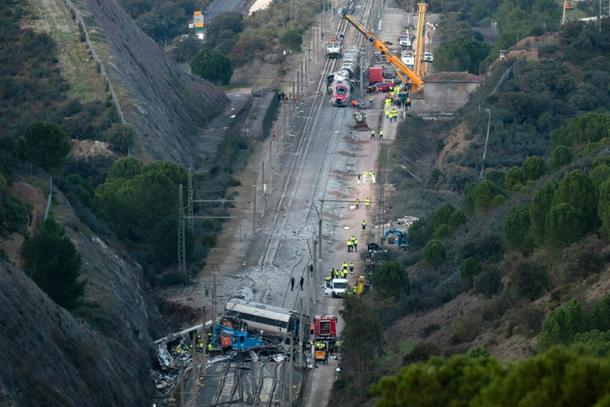
At least 43 people died in a crash between two high-speed trains on Sunday
“This situation of constant deterioration of the railway is unacceptable,” the union said in a statement.
Transport Minister Oscar Puente said the government would “sit down and talk” with the union to try to avoid the strike.
He also stressed during an interview with television station Telecinco that the two accidents were “completely unrelated”, with the Barcelona-area one linked to weather conditions.
Spanish media reported that the probe into the accident in Andalusia was focusing on a crack more than 30 centimetres (12 inches) long in the track at the site of the accident.
The crack may have resulted from “a poor weld or a weld that deteriorated due to train traffic or weather”, daily newspaper El Mundo said, citing unidentified technicians with access to the inquiry.
- ‘Proper material used’ -
Puente has said investigators are looking to see if a broken section of rail was “the cause or the result” of the derailment.
The section of track where the disaster happened had been renovated in May, making the accident “extremely strange”, he added earlier this week.
Some unions have accused the Socialist government of using low-cost materials, a charge Puente called “outrageous”.
“All proper materials were used. The results of the investigation will confirm this,” he told Telecinco.
Opened in 1992, Spain’s high-speed rail network is the second largest in the world after China.
Private operators began running passenger trains in 2021 following the liberalisation of the rail sector, ending the decades-long monopoly of state operator Renfe.
Since then, passenger numbers on some routes have grown noticeably.
Spain is the world’s second-most visited country after France, and the high-speed rail network plays an important role in the country’s key tourism sector.